Blog

Speech Delay Exercises at Home: Easy Ways to Help Your Toddler Speak
Many parents can feel concerned when their toddler does not communicate verbally on time. Speech delay is very common during early childhood. With early intervention and practice every day, most kids display constant improvement. Using speech delay home exercises, parents can actually get their child to listen, imitate, and speak with more confidence.
At Saanvihealthcare, we help parents through very simple and effective activities that physical therapists often recommend.
Why Practising Speech at Home is Important
Practising speech, Children at the toddler stage learn language. Speaking, playing, and listening develop effective communication skills. If the environment is safe for the children, they are more likely to attempt the use of more sounds and words.
Weekly homework
It increases verbal confidence. It improves verbal and non-verbal communication. It promotes faster language development. It reduces frustration in young children. At this stage, parents have the main influence on speech development.
Simple exercises to help with speech delays.
These exercise tasks for speech delay can be performed at home comfortably.
- Talking During Everyday Activities: Use daily activities as learning instances. During eating, bathing, and dressing: Speak slowly, Speak in short sentences, Key word repetition. Example –“Bath time. The water is warm. Soap on hands. Wash-wash!” This assists children in relating words to actions.
-
Read Picture Books Daily: Select the books that have attractive pictures and are wordless. Show pictures. State the object clearly, wait, and let your child do the action. Example: “You say: ‘Car. “The child tries the sound”. This exercise strengthens attention and word imitation skills.
- Practice Sound Imitation: Language begins with sounds before words. Teach simple sounds such as: ba, ma, pa, ta, da. Praise every effort, even ambiguous sounds. Positive feedback encourages the child to try again.
- Sing Rhymes and Action Songs: Learning through songs is an enjoyable experience. Use rhyming with Repetition. Add actions such as clapping and jumping. Please encourage your child to imitate movements and sounds. Rhymes help to facilitate the rhythm of speech.
- Ask Simple Choice Questions: Do not use yes/no questions. Use options like: “Milk or water?” “Ball or car?” Wait patiently for a response. Also, this encourages non-verbal communication over pointing.
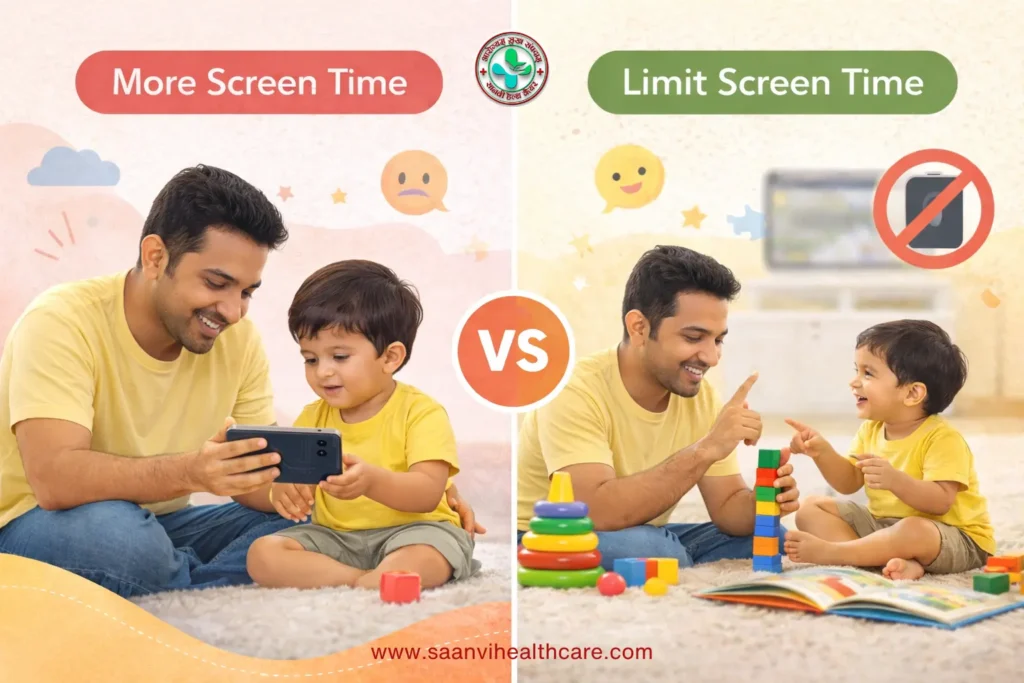
- Limit Screen Time: Excess exposure to screens hampers speech development. Screen time can be replaced with: Speaking, Playing together, Activity or experience: | Activity or experience description:, Learning language takes place through actual interaction
What is the best practice program?
Short and entertaining activities are most successful. Practice daily, Maintain playfulness in the session, Avoid Pressure, Even spending 10-15 minutes a day makes a huge difference.
When to Consult a Speech Therapist
You will require professional assistance if your child: No babbling by age 18 months, does not use two-word phrases until 2-3 years, can follow instructions, but has no speaking capability, and often gets frustrated due to communication barriers.
We at Blessings Neuro Developmental Clinic offer early assessment and individualized therapies by speech-language therapists.
We at Blessings Neuro Developmental Clinic offer early assessment and individualized therapies by speech-language therapists.
How Saanvi Healthcare Helps in Speech Development
At Saanvihealthcare, we emphasize early intervention and the inclusion of parents. Our strategy comprises: Child-friendly speech therapy, Parent training sessions, Parenting classes, Home-based activity guidelines, Whole child developmental support. It’s always better to act early.

FAQs
Q1. Are speech delay home exercises really effective?
Yes. Regular exercises for delayed speech performed at home are beneficial in enhancing vocabulary, imitation of sounds, as well as confidence levels.
Q2. How long does it take to see improvement?
Each child is unique. Some children show improvement in weeks, and others require more time. Practice is required for improved progress.
Q3. Is speech delay indicative of autism?
There is evidence to suggest that it is not always. Speech delay could occur alone or as a symptom of a different issue. To know the reason, an evaluation is necessary.
Q4. What is the appropriate time for me to consult a speech therapist?
If your child has delayed milestones or if they have difficulty expressing their needs, it is essential to seek the help of a speech therapist without delay.
Q5. Does Saanvi Healthcare provide speech therapy services for toddlers?
Yes. Saanvi Healthcare provides speech therapy sessions for toddlers in case of speech delay and language delay issues.
saanviHealthcare
0